

Heat collects upstairs because hot air rises, the attic above those rooms holds the afternoon sun long after sunset, and one thermostat downstairs has no idea any of that is happening. Zoning splits the house into separate areas with their own control, so the second floor stops being an afterthought of whatever the downstairs thermostat wants. It is usually paired with duct work, because a zone only performs as well as the air actually reaching it. This is a solvable problem, not something you live with.
Here's the short version:
- Upstairs rooms are fighting three things at once: rising warm air, a hot attic radiating down through the ceiling, and ducts that lose air before it arrives.
- A single thermostat downstairs satisfies itself first, then shuts the system off while the second floor is still warm.
- Zoning gives separate areas their own control, and measuring airflow room by room is what tells you whether zoning alone is enough.
Why the Second Floor Runs Hot
The easy explanation is that warm air rises, and that is true as far as it goes. It is rarely the whole story, and it is almost never the part you can fix.
The Attic Is the Real Load
A San Diego attic can sit far hotter than the outside air on a summer afternoon. That heat does not stay up there politely. It radiates down through the ceiling for hours, which is why upstairs bedrooms stay warm long after it has cooled off outside and the windows are open. If your second floor feels worse at eight in the evening than it did at two in the afternoon, you are feeling stored attic heat, not outdoor heat.
The Ducts Are in the Worst Possible Place
In most two story homes the supply runs feeding upstairs rooms sit in the attic. That means the air you already paid to cool is traveling through the hottest space in the building on its way to the room that needs it most. Leaks and long undersized runs make it worse. The register still blows, so nothing looks broken, but the air arriving is warmer and thinner than the air that left the equipment.
One Thermostat, Two Different Houses
A single thermostat only knows the temperature of the wall it is mounted on, and that wall is usually downstairs. Once the ground floor hits its setpoint, the system shuts down. Upstairs never got there. Homeowners then drop the setpoint lower to force more runtime, which overcools the first floor and costs more without ever solving the second floor.
What Zoning Actually Does
Zoning divides the house into separate controlled areas, typically upstairs and downstairs in a two story home, and lets each one call for air on its own. The second floor stops depending on what the first floor thinks. That is the whole idea, and it is why Ducting & Zoning work usually starts with airflow measurement at each room rather than with equipment.
Measurement matters because zoning is not always the answer by itself. If a bedroom is only receiving a fraction of the air it needs, giving it its own thermostat just means it runs longer and still falls short. The fix there is duct work first, either a full re-duct or a single replacement run, and zoning layered on top. Zoning also retrofits onto a system you already have in many houses, so it is not automatically a full equipment replacement conversation.
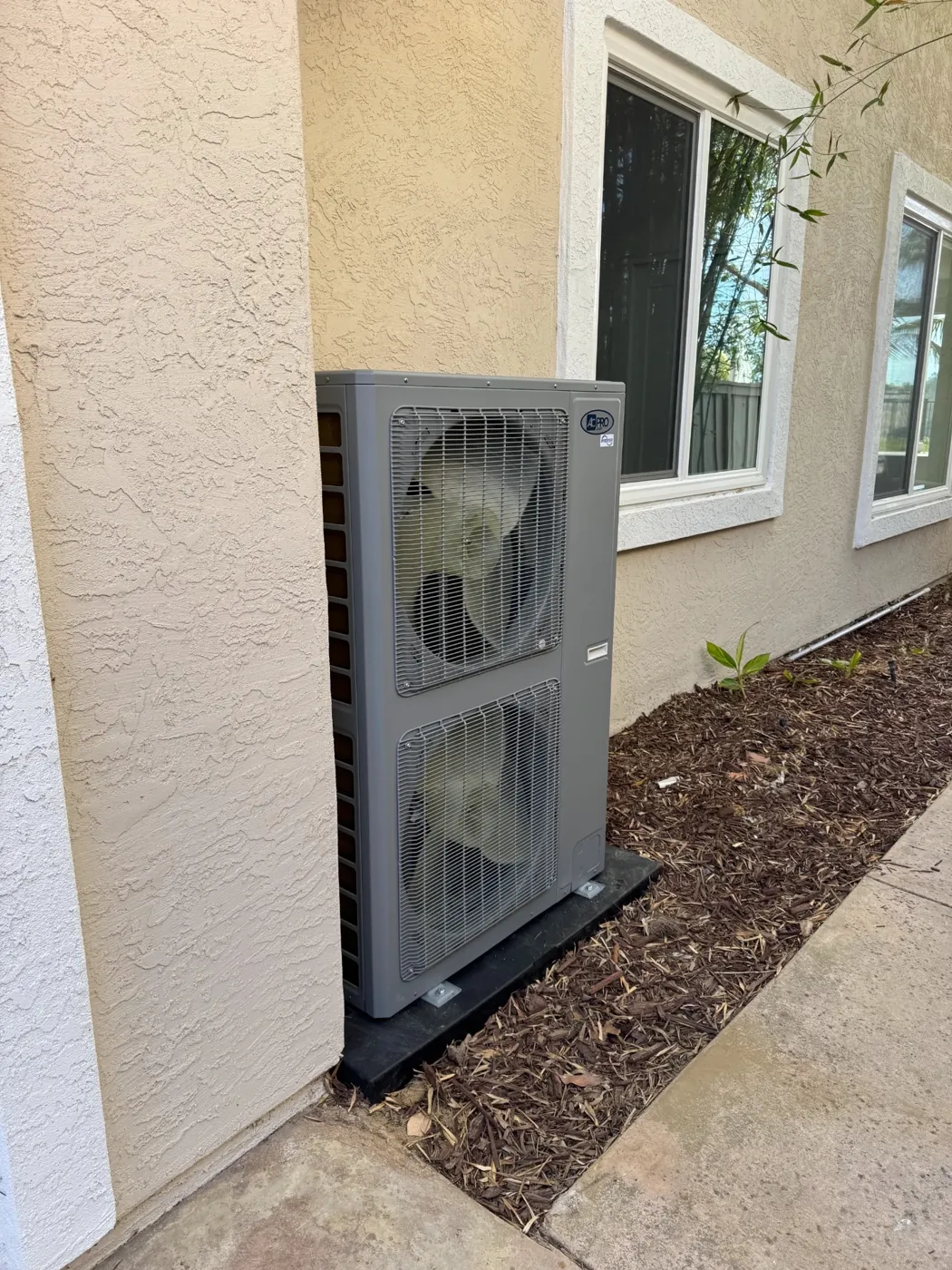
Supply ducting running through an attic space above the second floor ceiling.
Comparing the Common Fixes
Different causes call for different work. Here is how the usual options line up for a hot upstairs.
| Approach | What it addresses | Good fit when |
|---|---|---|
| Zoning | One thermostat controlling two very different floors | The upstairs gets decent airflow but always lags the downstairs setpoint |
| Duct replacement or re-ducting | Air lost or warmed in the attic before it reaches the room | Registers blow weakly, or the air arriving feels barely cool |
| Attic fan | Stored attic heat radiating down through the ceiling | Upstairs stays warm well after sunset and the attic is noticeably hot |
| Ductless mini split | A room with no practical way to get ducted air | A converted garage, an ADU, a bonus room over the garage, or an older house without ducts |
| Whole house fan | Trading hot indoor air for cooler evening air | Evenings outside are cooler than the house and you want less compressor time |
An Attic Fan Installation is worth understanding as a separate job from a whole house fan. An attic fan exhausts superheated air out of the attic itself. A Whole House Fan moves air through your living space, pulling cool outside air in through open windows and pushing trapped hot air out through the attic vents. They solve related problems in different ways, and attic temperature and vent area should be measured before either one gets cut into a roof.
For a room that simply has no way to receive ducted air, Mini Split Installation is the usual answer. Each head is its own zone, so you are not conditioning the whole house to fix one room.
How CrossBreeze Heating & Air Approaches It
CrossBreeze Heating and Air is a Filipino owned HVAC company founded by Eddie Layola in 2018, working out of Mira Mesa and serving San Diego, the South Bay and East County. Eddie holds the California C20 license and is usually the one who comes out to the house, so the person diagnosing your system is the person whose name is on the company. The company is licensed, bonded and insured under CSLB #1055889, and rated 5.0 across 26 Google reviews.
On a hot upstairs, we measure airflow at each room before recommending anything, and we measure attic temperature before quoting an attic fan. Zoning for two story homes, full re-ducts, single runs and retrofits onto the system you already have are all on the table, and which one you need depends on what the measurements show rather than on what sells best.
One customer, Richard H., wrote: "So hard to find good contractors these days but Eddie and his team definitely delivers. Great pricing, excellent work and a real pleasure to work with."
We serve San Diego, Chula Vista, National City, Bonita, Spring Valley, La Mesa, El Cajon, Santee, Poway, Del Mar, Encinitas, Mira Mesa, Scripps Ranch, Clairemont, Pacific Beach and the surrounding communities. If your second floor has never been comfortable, tell us what is going on or call 760-715-0523 and we will get right back to you.
FAQs
Can zoning be added to my existing system?
In many houses, yes. Zoning retrofits onto the system you already have, which is why it is worth measuring before assuming you need new equipment. The deciding factor is usually whether your current ducting can deliver enough air to the rooms in question.
How do I know whether I need zoning or new ducts?
Airflow measurement at each room answers it. If the upstairs registers are delivering reasonable air and the rooms just never reach setpoint, zoning is the likely fix. If the air arriving is weak or warm, the ducts come first.
Would an attic fan alone fix my hot upstairs?
It helps with one specific cause, which is attic heat radiating down through the ceiling for hours after sunset. If that is what you are feeling, an attic fan addresses it directly. If the room also has poor airflow or no separate control, the fan is only part of the answer.
What about a room with no ductwork at all?
That is the usual case for a ductless mini split. It mounts on the wall and connects to an outdoor unit through a small line set, so no ducting is needed. Common applications are converted garages, ADUs, bonus rooms over the garage and older San Diego homes that never had ducts.