Signs Your San Diego AC Needs Repair Before Summer
If your AC is blowing warm air, running for hours, making odd noises, leaking water, or sending your power bill up, I’d get it checked before summer. In San Diego, a system can seem fine on a mild 72°F day and then struggle when temps hit 90°F+. That gap is where many AC problems show up.
Here’s the short version:
- Warm air can point to thermostat, airflow, condenser, or refrigerant trouble
- Long run times often mean the system is working too hard
- Weak airflow may come from a dirty filter, blower issue, or duct leak
- Hot and cold spots can mean one room has a vent or duct problem
- Short cycling puts extra strain on the compressor
- Banging, buzzing, grinding, or hissing should not be ignored
- Water or ice around the unit usually means drain, airflow, or refrigerant issues
- Higher energy bills and sticky indoor air can signal lower AC performance
- Late winter to early spring is often the best time to book service before schedules fill up
A few simple checks can help first: make sure the thermostat is set to Cool, the fan is on Auto, the filter is clean, and the outdoor unit fan is spinning. If you see ice, standing water, or smell something burning, turn the system off and call for service.
That’s the main idea: small AC issues often show up before summer, and waiting can turn a repair into a bigger problem.
The 5 Most Common A/C Calls We get Every Summer (and How to Avoid Them)
sbb-itb-207f1b2
Warm air, long run times, and weak cooling
Warm air from the vents and extra-long cooling cycles are early signs that your AC may need attention.
What warm air from vents may point to
Start with the thermostat fan setting. If the fan is set to "On" instead of "Auto," the blower keeps running even when the system isn't cooling. That can send unconditioned air through the vents.
Next, check the air filter. If you can't see light through it, replace it. A clogged filter can choke airflow and cause the evaporator coil to freeze. When that happens, cool air has a hard time reaching your rooms.
The outdoor condenser unit may also be part of the problem. If the fan on top isn't spinning, or the unit hums but doesn't run, the cause may be a failed capacitor or a breaker issue. At that point, it's time to call a technician.
Refrigerant is not a DIY job. It doesn't get "used up" over time, so low refrigerant usually means there's a leak somewhere in the system. A technician needs to find the leak and repair it.
If the thermostat setting and filter look fine, the issue is often somewhere inside the system itself.
When the AC runs but the house still does not cool down
If your AC runs for a long time and still can't reach the temperature you set, something is off. A working system should lower indoor temperature at a steady pace. If it's been running for hours and the temperature barely changes, the system is struggling.
One pattern to watch for: the AC keeps up in the morning but falls behind in the afternoon. That's often a sign the system can't handle peak demand. Problems like a weak capacitor, dirty condenser coils, or low refrigerant may stay hidden on a mild day. But once the system has to work hard for several hours, they start to show.
When long run times also come with weak airflow, the next warning signs often point to a deeper repair.
Weak airflow, uneven temperatures, and unusual cycling
Low airflow from vents or rooms that stay warmer than others
Start by figuring out whether the weak airflow is limited to one room or shows up across the whole house.
If just one room stays warm while the rest of the house feels normal, the cause is often local. Common culprits include a blocked supply register, furniture in front of a return vent, or a duct leak in that branch. A simple walk-through can tell you a lot. Check that all supply vents are open, make sure nothing is covering a return air grille, and look at whether a closed door is cutting off return air in a room that needs the door open.
If airflow is weak from most or all vents, the problem is more likely house-wide. A dirty filter, blower issue, coil problem, or duct trouble can all cut airflow. Leaky ducts can also waste cooled air fast.
If you see ice on the indoor unit or refrigerant lines, shut the system off and let it thaw before service. Do not scrape the ice, as that can damage the coil.
There’s a useful pattern here: one warm room usually points to a local blockage or duct leak, while weak air everywhere points to a filter, blower, or duct problem.
Short cycling or running almost constantly
Airflow trouble often changes how long the system runs. And here’s the tricky part: two opposite patterns can both point to trouble.
- Short cycling means the system shuts off after only a few minutes.
- Running nonstop means it can’t cool the house to the set temperature.
Short cycling puts repeated stress on the compressor, which is one of the most expensive parts to repair or replace. It can happen because of a thermostat problem, a failing capacitor, or an oversized system that cools the area near the thermostat too fast before the rest of the house catches up.
When you call for service, a couple of notes can save time. Write down about how long each cycle lasts and whether the thermostat screen flickers or resets. That gives the technician a better starting point and can help narrow the cause faster.
Noises, odors, moisture, and other signs that need prompt attention
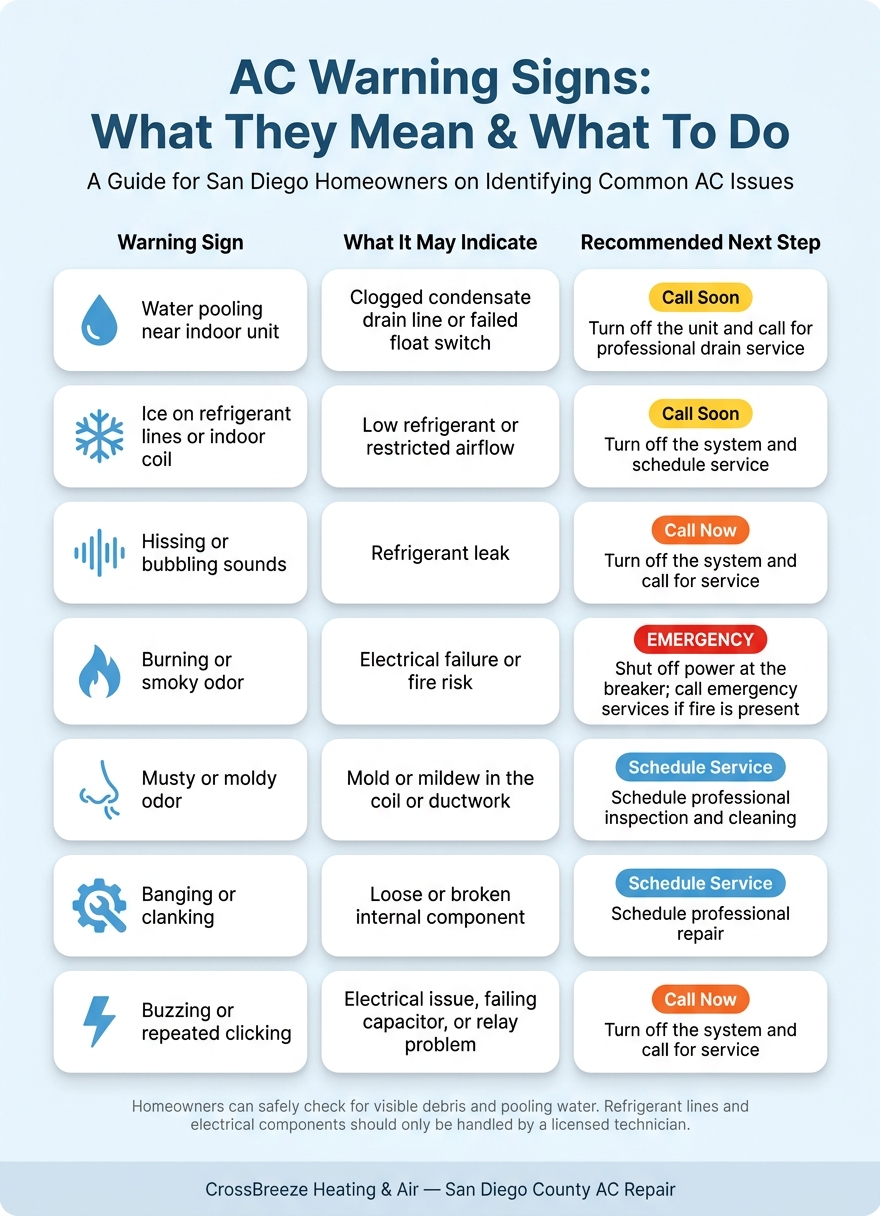
AC Warning Signs: What They Mean & What To Do
Sounds and smells that should not be ignored
If weak airflow comes with odd sounds, strange smells, or moisture, this usually isn’t just a dirty filter anymore.
Once an AC issue turns into a mechanical or electrical problem, the system tends to make that pretty clear. Banging or clanking often points to a loose or broken part. Grinding usually means worn bearings. Buzzing can point to an electrical issue. Hissing or bubbling often signals a refrigerant leak.
Smells can tell you just as much. A musty or “dirty sock” odor usually means mold or mildew has built up on the evaporator coil or inside the ductwork. A sweet or chemical smell can point to a refrigerant leak.
A burning smell is different. Treat it like an emergency. Turn the system off at the thermostat and breaker, and call emergency services if you see smoke or sparks.
Water, ice, and visible signs around the unit
If you notice noise or odor, check for water or ice next. These signs often show up together.
Water or ice around the indoor unit usually points to a drainage or airflow issue. Pooling water near the indoor unit usually means the condensate drain line is clogged or the float switch has failed. Ice on the refrigerant lines or indoor coil can point to a drain issue or restricted airflow and needs service. Turn the system off and schedule a visit.
Use the table below to match the sign with the next step.
| What You See or Hear | What It May Indicate | Appropriate Next Step |
|---|---|---|
| Water pooling near indoor unit | Clogged condensate drain line or failed float switch | Turn off the unit and call for professional drain service |
| Ice on refrigerant lines or indoor coil | Low refrigerant or restricted airflow | Turn off the system and schedule service |
| Hissing or bubbling sounds | Refrigerant leak | Turn off the system and call for service |
| Burning or smoky odor | Electrical failure or fire risk | Shut off power at the breaker; call emergency services if fire is present |
| Musty or moldy odor | Mold or mildew in the coil or ductwork | Schedule professional inspection and cleaning |
| Banging or clanking | Loose or broken internal component | Schedule professional repair |
| Buzzing or repeated clicking | Electrical issue, failing capacitor, or relay problem | Turn off the system and call for service |
Homeowners can safely look for visible debris around the outdoor unit and check for pooling water. Refrigerant lines and electrical parts should be handled only by a licensed technician.
High energy use, safe checks, and scheduling repair before summer
Rising energy bills and changes in indoor humidity
If your electric bill has gone up and you haven't changed how you use your AC, that's a red flag. In many cases, it means the system is running longer than it should.
Put simply: higher bills often mean lower efficiency.
When an AC starts losing efficiency, it has to work harder to hit the same temperature. That extra runtime shows up on your monthly bill.
Humidity can also tell you a lot. If the air feels sticky even while the AC is on, the system may not be pulling moisture out of the air the way it should. That often shows up with weak airflow or longer cooling cycles.
Safe checks homeowners can do before calling for service
If your bill has changed or your home just doesn't feel as comfortable, start with the simple stuff first.
Check the thermostat. Make sure it's set to Cool and the fan is set to Auto.
Then look at the air filter. If it's gray or dusty, replace it. And if it's been more than three months since the last filter change, swap it out before doing anything else.
A few other quick checks can help:
- Notice which rooms stay warmer than the rest
- Confirm the outdoor fan is spinning when the cooling is on
- Look for ice on the refrigerant lines or the indoor coil
- Check for water pooling near the indoor unit
If you see ice or standing water, turn the cooling off and run the fan only so the system can thaw. After that, call for service.
It also helps to write down anything odd, like strange sounds, unusual smells, or rooms that never seem to cool off. Those notes give the technician a better starting point and can shorten the diagnostic visit.
Conclusion: When to schedule AC repair before summer arrives
The warning signs in this article, like warm air from vents, weak airflow, short cycling, unusual noises, moisture around the unit, and higher energy bills, usually don't hit all at once. They tend to creep in over time. An AC that barely made it through last September may struggle during the first big summer heat wave.
In San Diego, the best time to schedule an evaluation is usually late winter or early spring, especially January through March. That's before demand spikes and open appointment slots get harder to find.
Wait until July or August, and you're more likely to deal with emergency calls, fewer technician openings, and parts that may be backordered.
If any of these signs sound familiar, it's smart to book repair before peak heat shows up. CrossBreeze Heating & Air handles AC repair, AC installation and replacement, ductless mini split installation, and furnace and heating repair across San Diego County.
FAQs
How urgent are early AC warning signs?
Early AC warning signs usually need prompt attention. They almost never fix themselves, and they often point to issues that get worse with time. If you brush off weak airflow, odd noises, or uneven cooling, you could end up with a full system breakdown, especially during San Diego heat waves.
A few small problems can wait for a scheduled service call. But burning smells, electrical issues, refrigerant leaks, and ice buildup should be checked right away to help avoid expensive repairs or safety risks.
Can a dirty filter really cause bigger AC problems?
Yes. A dirty air filter can choke off airflow over the evaporator coil. When that happens, your AC has to work harder, pull more power, and deal with extra wear over time.
If airflow drops too far, the coil can freeze up and your system may stop cooling. Dirty filters can also allow debris to reach the coil and clog the condensate drain line. CrossBreeze Heating & Air recommends regular maintenance to help prevent these problems.
When should I call for AC repair instead of troubleshooting myself?
Start with a few basic checks. Make sure the thermostat is set the way you want, check that the air filter isn't dirty, and confirm the circuit breakers haven't tripped. If none of that fixes the issue, it's time to call a professional.
Call right away if you notice burning smells, grinding or buzzing noises, ice on the lines or coils, or the system stops cooling altogether. CrossBreeze Heating & Air can diagnose these problems before they turn into a full breakdown.