
How Ductless Mini Splits Work in Older San Diego Homes
If your older San Diego home has no ducts, a mini split is often the simplest way to add heating and cooling room by room.
I’d boil it down like this: a ductless mini split uses one outdoor unit, one or more indoor units, and a small wall opening of about 3 inches to move heat in or out of a room. You skip major duct work, get separate temperature control by room, and can often target hot spots like upstairs bedrooms, west-facing rooms, garage conversions, and sunrooms.
Before install, I’d check these first:
- System size: A Manual J load calculation is better than guessing by square footage alone.
- Zone plan: Decide between single-zone for one room or multi-zone for several rooms.
- Electrical panel: Older homes may still have 60-amp or 100-amp service, and mini splits usually need a 208V or 240V dedicated circuit.
- Drainage: Condensate has to drain outside or use a pump if slope is a problem.
- Placement: Indoor airflow, outdoor noise, and line-set routing all matter.
- Permits: San Diego may require a mechanical permit, and some historic areas may need extra review.
- Noise: Outdoor equipment must meet the city’s 60-decibel limit at the property line.
A few tradeoffs are worth knowing upfront. The indoor heads stay visible on the wall, filters often need cleaning every 30 to 60 days, and older plaster walls or hidden wiring can make placement harder.
So if you want the short answer: mini splits work well in many older San Diego homes because they move heat without ducts, need less wall opening than central HVAC retrofits, and let you cool or heat the rooms that need it most.
ULTIMATE Mini Split Install Guide to Save You THOUSANDS
sbb-itb-207f1b2
How a Ductless Mini Split Works
A ductless mini split moves heat with a small group of connected parts. It doesn’t rely on ductwork. Instead, it shifts heat where it needs to go.
The Main Parts and How They Connect
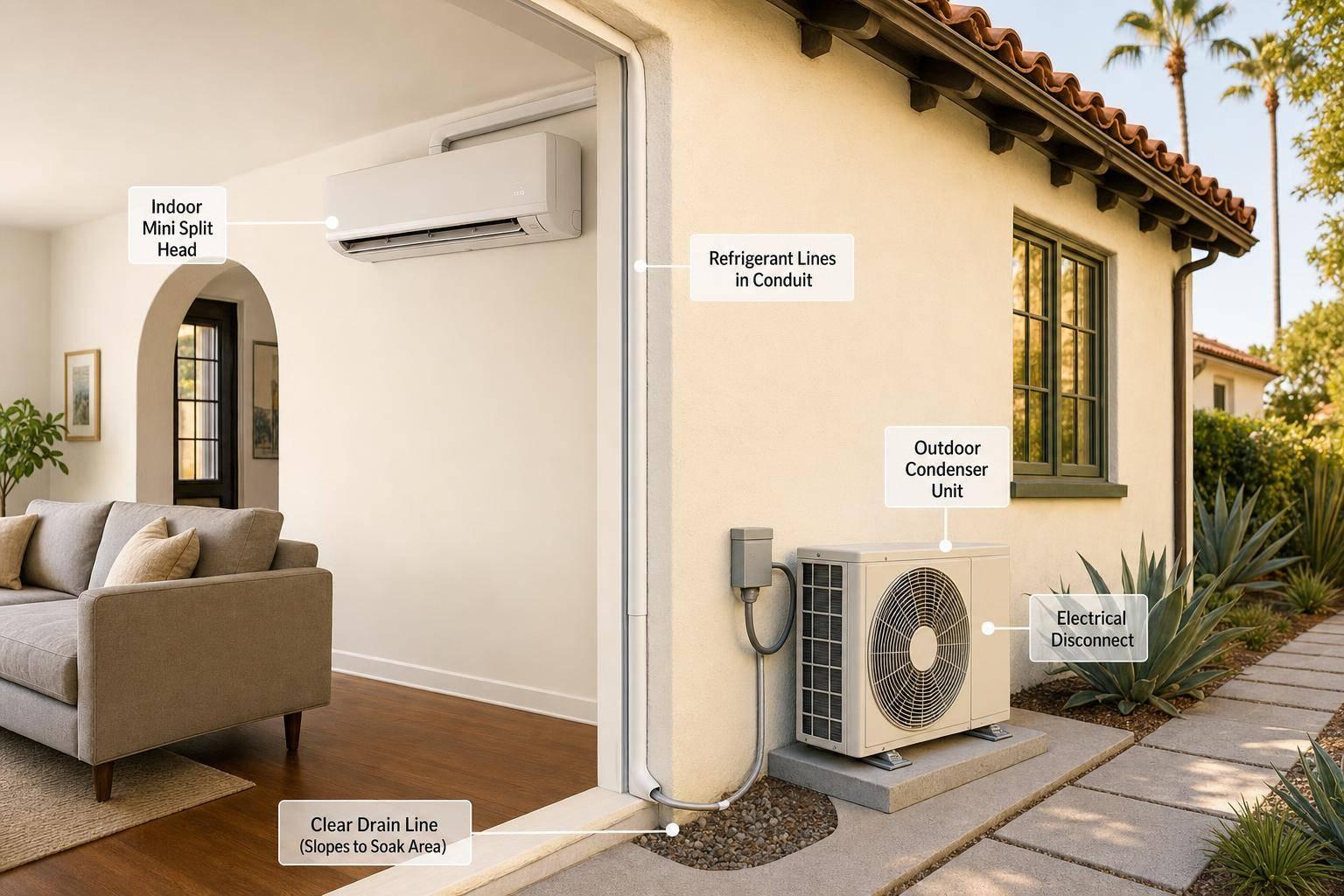
A ductless mini split has two main parts: an outdoor condenser and one or more indoor air handlers. The outdoor unit holds the compressor and sits outside the home. The indoor unit is usually mounted high on a wall in the room it serves.
The two units connect through a small wall opening. That opening carries the refrigerant lines, wiring, and condensate drain.
How the System Moves Heat In and Out of a Room
In cooling mode, the indoor unit pulls warm air from the room across a cold coil. The refrigerant takes in that heat and sends it outside. Then the system blows cooled air back into the room.
In heating mode, the process flips. A valve in the outdoor unit reverses the refrigerant flow, so the system pulls heat from the outdoor air and brings it inside to warm the room. That may sound odd at first, but heat pumps work by moving heat, not making it from scratch.
Many modern mini splits also use inverter-driven compressors. That means the system can speed up or slow down based on the room’s load instead of turning fully on and off over and over. In plain terms, it helps keep temperatures more even and cuts those big energy spikes.
That same basic setup can handle one room or several, depending on the home.
Single-Zone vs. Multi-Zone Setups
After the parts and heat flow make sense, the next step is figuring out how many rooms the system needs to handle.
A single-zone system connects one outdoor unit to one indoor air handler. It works well for one problem area, like a garage conversion, a main bedroom, or a sunroom that always seems a little too hot or too cold.
A multi-zone system connects one larger outdoor condenser to several indoor air handlers. Each handler runs on its own, so each room can have a different temperature setting. That makes this setup a good match for older homes without ductwork.
Why Older San Diego Homes Often Work Well with Ductless Installation
Many older San Diego homes, especially 1920s Craftsman bungalows and mid-century ranches, were never designed for central air. Their attics, wall cavities, and crawl spaces are often too tight to handle new ductwork.
That’s why a forced-air retrofit can turn into a big renovation fast.
A ductless mini split skips most of that mess. Instead of pushing air through long ducts, it sends air straight into the room. That also helps avoid duct losses. In a lot of older homes, the best use case isn’t cooling the entire house at once. It’s fixing the rooms that never seem to feel right.
Rooms That Often Benefit Most
Some rooms in older homes are just harder to keep comfortable than others. One thermostat can’t always smooth out those room-to-room swings.
Upstairs bedrooms often get much warmer in summer. West-facing rooms that take on the afternoon sun can stay uncomfortable for hours, even when the rest of the house feels okay.
Converted garages, sunrooms, and home offices also tend to be strong fits. These areas are often the toughest to serve with existing HVAC, which is why they come up so often in ductless projects. A single-zone mini split can handle each of these spaces without forcing changes on the rest of the home.
Why Installation Is Less Disruptive Than Major Duct Work
There’s also the construction side of it. Adding ductwork to an older home often means opening walls, lowering ceilings, or giving up closet space to run trunk lines. In homes with older plaster, trim, and tighter ceiling space, that kind of work can be a headache and hard to undo cleanly.
A ductless setup usually needs only a small wall opening for the line set.
That said, the home’s layout still matters. Wall type, floor plan, and condenser location can all shape the job. In historic districts, permit review may also come into play for exterior unit placement or line routing.
An on-site review helps sort out what the house can handle, including layout, wiring, and routing limits. After that, a professional review helps pin down the final plan, since system sizing and line routing will affect how the installation comes together.
What to Check Before Installation Begins
Older San Diego homes need a bit more homework before installation starts. Before anyone orders equipment, you want to check sizing, placement, power, and drainage.
Sizing, Zone Planning, and Unit Placement
Room size by itself doesn't tell you what size mini split to buy. A proper Manual J load calculation looks at square footage, insulation, windows, and sun exposure, not just the size of the room.
Placement matters just as much. Indoor units should sit where air can move through the space without blowing straight at people. Installers also need enough room to work around studs and leave access for future service. On the outdoor side, noise can’t be an afterthought. San Diego Municipal Code Section 59.0306 limits outdoor unit noise to 60 decibels at the property line. So the condenser location should be planned with nearby homes and lot lines in mind.
Once sizing and placement are nailed down, the next step is checking electrical capacity, drainage, and line routing.
Electrical, Drainage, and Line Routing
Many older San Diego homes still have 60-amp or 100-amp panels. A mini split needs a dedicated 208-volt or 240-volt circuit, and some homes may need a subpanel or a service upgrade first. Even a simple photo of the panel schedule can help a contractor size up the existing service.
Drainage needs just as much attention. The indoor unit creates condensate, and that water has to go somewhere. A gravity drain with a slope to the exterior is usually the best option, but older layouts don’t always make that easy. If gravity drainage won’t work, the plan should include a condensate pump from day one so you don’t end up with water damage later.
For refrigerant lines, shorter is usually better. The goal is the shortest practical route so there’s less exposed line set and the system can run as intended.
Older-Home Conditions, Permits, and Professional Review
Older homes can hide problems behind the walls. Lath-and-plaster can crack or crumble during drilling, so installers need to check wall thickness and mounting strength before picking a final location. Old wiring or plumbing can also show up right where the line set needs to run.
If the home is in a historic district such as Kensington or Burlingame, exterior equipment placement and wall penetrations may need review by the San Diego Historical Resources Board, or HRB. The City of San Diego also requires a mechanical permit for a new HVAC installation, and California's Title 24 energy code may require HERS field verification.
That’s why permit and code checks shouldn’t be treated like paperwork you deal with later. They’re part of the same planning process and should be confirmed before equipment is ordered.
Installation Steps, Benefits, and Key Takeaways
How Ductless Mini Splits Are Installed in Older San Diego Homes
How Installation and Startup Typically Go
Once the layout and permit details are locked in, the install usually moves pretty fast. Single-zone systems tend to go in faster than multi-zone systems.
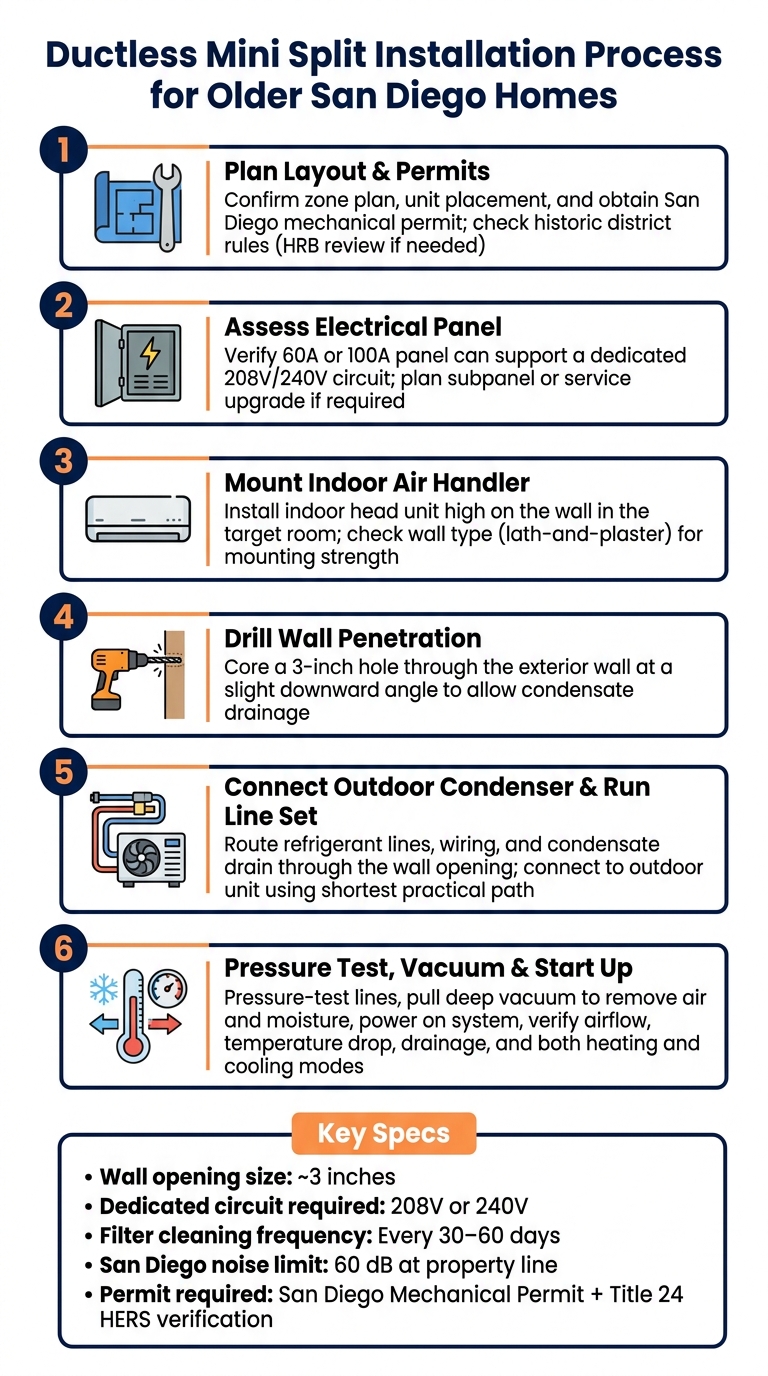
The process is pretty straightforward. The installer mounts the indoor head high on the wall, then drills a 3-inch hole through the exterior wall at a slight downward angle so condensate can drain outside. After that, the outdoor condenser is connected on the exterior.
From there, the technician pressure-tests the lines and pulls a deep vacuum to remove air and moisture. Then comes startup: the system is turned on, and the installer checks airflow, temperature drop, drainage, and both heating and cooling performance.
After startup, the homeowner’s part is simple. You just need to learn the basic controls and how to handle filter care. The visit usually wraps up with a walkthrough that shows you how to use the remote, switch modes, and clean the filters.
Potential Benefits and Things to Keep in Mind
The upside is simple: less disruption, room-by-room control, and a cleaner fit for older homes that don’t have ducts. That’s a big deal if you want better comfort without opening up a bunch of walls.
There are a few tradeoffs, though. The indoor heads stay visible on the wall, and the exterior line sets may also be visible along the outside wall. Filters also need cleaning every 30 to 60 days for each indoor head.
Older homes can add a few wrinkles too. Hidden conditions may affect routing and install planning, and a condensate pump may be needed if gravity drainage isn’t possible.
What Homeowners Should Take Away
A ductless mini split moves heat by linking an outdoor condenser to one or more indoor heads through a small wall penetration. For older San Diego homes without existing ductwork, that setup can be a practical way to improve comfort without tearing into walls or ceilings.
The system tends to work best when the planning happens first. A professional assessment can confirm the layout, electrical panel capacity, drainage path, and zone needs before installation.
FAQs
How many rooms can one mini split handle?
It depends on the system. In most cases, a single outdoor mini split unit can support three to five indoor heads. Each head controls its own room or zone, which is why these systems work well when you want different areas of the house set at different temperatures.
In many San Diego homes, three to four heads is a common setup. Bigger homes with more than 2,500 square feet often need something more involved, especially if there are more rooms to cool or heat.
Will my older electrical panel support a mini split?
It depends on your home’s current electrical capacity. Many older San Diego homes still have 60- to 100-amp panels, and that may not be enough to handle a modern mini split on top of the appliances and systems you already use every day.
If your panel doesn’t have enough capacity, you may need a 200-amp service upgrade. CrossBreeze Heating & Air can review your electrical needs during a site survey.
Do mini splits work well in summer and winter?
Yes. Modern ductless mini splits cool your home in summer and heat it in winter because they work as heat pumps.
Here’s the simple version: in summer, they pull heat out of your home. In winter, they flip that process and bring heat inside.
That makes them a good fit for San Diego, where the weather stays fairly mild through most of the year. In this kind of climate, mini splits can run with good efficiency in both seasons.
CrossBreeze Heating & Air can help figure out the right size system for your home, which matters more than most people think. A unit that’s too small may struggle to keep up, while one that’s too large can cycle on and off too often.