Why Your Furnace Smells Like Dust When You First Turn It On
A mild dusty smell when your furnace first starts usually means settled dust is burning off. I’d focus on whether it fades - not just the clock. Burn-off often clears within 30 minutes to a few hours, but a stronger or recurring smell calls for an inspection.
Here’s how I’d handle it:
- Mild and fading: Turn the system off before checking the user-accessible filter, keep vents clear, and ventilate briefly. Don’t open service panels.
- Persistent, electrical, plastic, or chemical odor: Stop using the furnace and schedule an inspection. Don’t run extra cycles to burn it off.
- Gas odor, a CO alarm, or active smoke: <u>Leave immediately</u> and call for help from outside. Call 911 for a CO alarm or suspected fire; contact your gas utility or 911 for a gas leak. Don’t use switches or phones indoors if you suspect gas.
Carbon monoxide has no smell. I wouldn’t use odor alone to judge whether a furnace is safe.
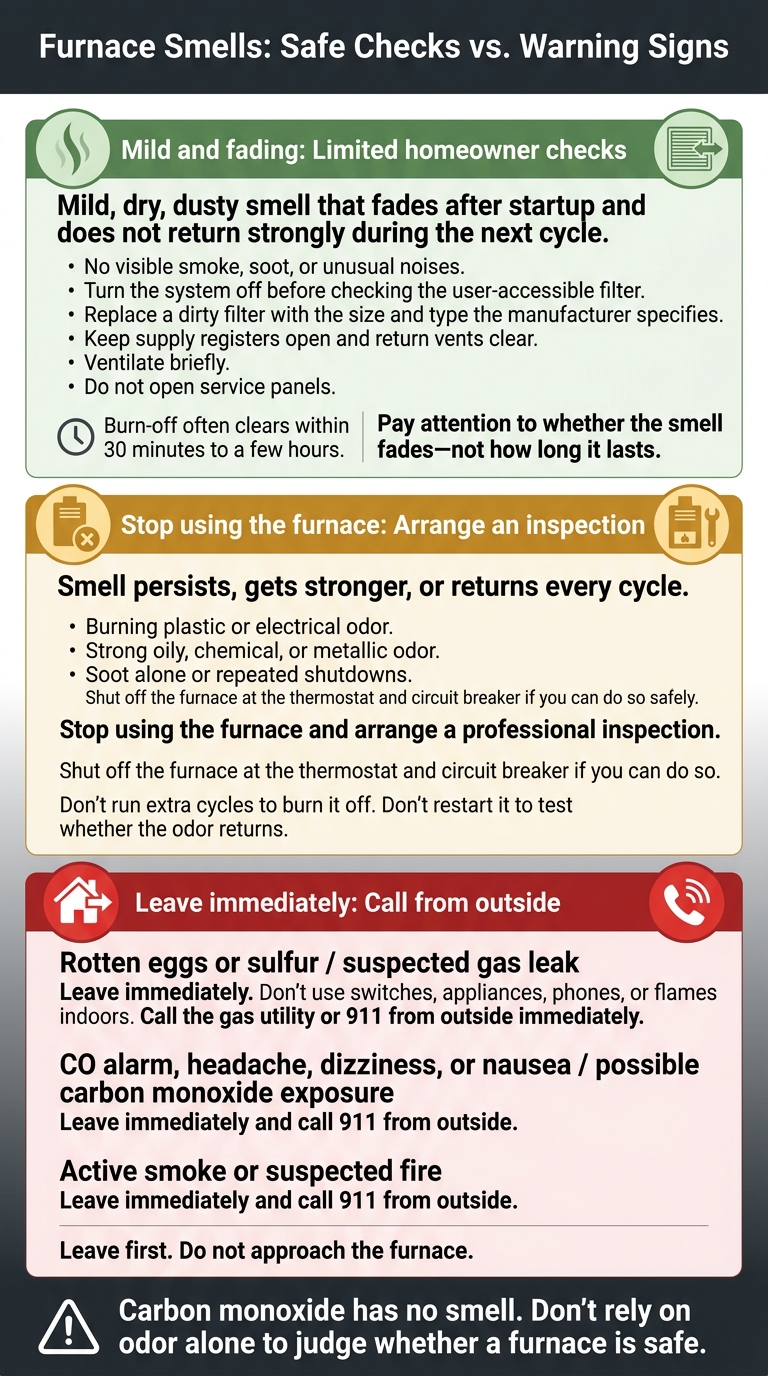
Furnace Smells: Safe Checks vs. Warning Signs
What Causes the Smell and When It Is Normal
How Dust Collects Between Heating Seasons
When your furnace sits unused for months, dust settles on the heat exchanger, burners, blower parts, and nearby duct surfaces. A new furnace may also give off a different smell during its first few uses as manufacturing residue, such as protective oil on metal parts, heats up.
Signs of Normal Dust Burn-Off
Normal dust burn-off produces a mild, dry, dusty smell that fades soon after startup and doesn’t return strongly during the next cycle. There should be no visible smoke, soot, or unusual noises.
Pay attention to whether the smell fades - not how long it lasts. If it gets stronger, lingers, or returns every cycle, schedule an inspection. A smell that won’t fade or keeps coming back is no longer routine dust burn-off.
sbb-itb-207f1b2
Warning Signs That Need Immediate Action
An odor stronger than a mild dust burn-off needs attention. The smell alone can't tell you what's wrong with the furnace. Use the chart below to check whether you need to leave immediately or shut off the system.
| Odor or symptom | Possible concern | Recommended response |
|---|---|---|
| Rotten eggs or sulfur | Natural gas leak | Leave immediately. Don't use switches, appliances, phones, or flames indoors. Call the gas utility or 911 from outside immediately. |
| CO alarm, headache, dizziness, or nausea | Carbon monoxide exposure | Leave immediately and call 911 from outside. |
| Burning plastic or electrical odor | Overheating motor or damaged wiring | Shut off the furnace at the thermostat and circuit breaker if you can do so safely. Arrange a professional inspection. |
| Strong oily, chemical, or metallic odor | Cracked heat exchanger or melting wire insulation | Stop using the furnace and arrange a professional inspection. |
| Visible smoke or soot | Active fire or severe combustion problem | If there's active smoke or a suspected fire, leave immediately and call 911 from outside. For soot alone, shut off the furnace and arrange an inspection. |
Gas Smells and Carbon Monoxide Alerts
Gas leaks smell like rotten eggs because utilities add an odorant to the gas. Carbon monoxide has no smell, so don't rely on your nose to detect it.
Electrical or Chemical Smells, Smoke, and Soot
Don't restart the furnace to see whether the odor comes back. If there's active smoke, a suspected fire, or a gas odor, leave first. Do not approach the furnace.
Safe Checks for a Mild Start-Up Smell
Only try these checks for a mild dusty odor that fades and has no warning signs. If the smell persists or gets stronger, shut the furnace off. These are the safest checks you can make before calling for service.
Check the Filter and Registers
Turn the system off before checking the filter. Use only the user-accessible filter slot. Do not open service panels. If the filter is dirty - even if it’s a 1-inch filter - replace it with the size and type the manufacturer specifies.
Make sure supply registers are open and return vents are clear of furniture, curtains, and dust. Blocked airflow can cause the furnace to overheat and shut down repeatedly.
Ventilate Briefly and Check Whether the Smell Fades
Open a window or run exhaust fans briefly to help clear a mild odor. Do not run extra cycles to burn off a smell that persists. If the odor doesn’t fade, turn the system off and arrange a professional inspection.
Why the Smell May Keep Returning
A smell that returns every cycle is no longer normal dust burn-off. Dust on internal parts or another operating problem may be the cause.
Keep homeowner checks limited to the filter and visible exterior. Do not open the furnace cabinet, clean burners, inspect wiring, or attempt gas repairs. If the smell keeps returning, stop using the furnace and arrange an inspection.
Conclusion: When to Schedule Furnace Repair
Schedule an inspection if the smell doesn’t fade, comes back, or lingers after a filter change. Soot or repeated shutdowns also call for an inspection.
If you smell gas, hear a CO alarm, or see active smoke, leave immediately and call the gas company or 911 from outside. Don’t use switches if you suspect a gas leak.
An HVAC technician can check the filter, blower, heat exchanger, burners, and duct connections.
FAQs
Can a dusty furnace smell trigger my allergies?
Yes. When you first turn on your furnace for the season, dust, pet hair, and debris on furnace parts and inside ductwork can circulate through your home alongside a burning smell. These particles can trigger allergies.
Replace your air filter before the first heating cycle to help reduce airborne particles and ease allergy symptoms.
How can I prevent furnace odors before heating season?
Replace your air filter before heating season to improve airflow and help prevent dust and debris from building up and burning off during the first few heating cycles. Keep stored items away from your furnace so air can flow freely.
Before turning on the heat, schedule maintenance with CrossBreeze Heating & Air. A technician can clean internal components and help your system run safely and efficiently.
What should I tell a technician about my furnace’s smell?
Describe the smell and where it seems to come from. Does it smell like burning dust, plastic, electrical wiring, or rotten eggs? Tell the technician how long it has lasted, whether it’s getting stronger, and whether it returns after the initial startup. These details help them pinpoint the cause.
If you suspect a problem, contact CrossBreeze Heating & Air in San Diego.