
How Long a Central Air Conditioner Lasts in a Coastal Climate
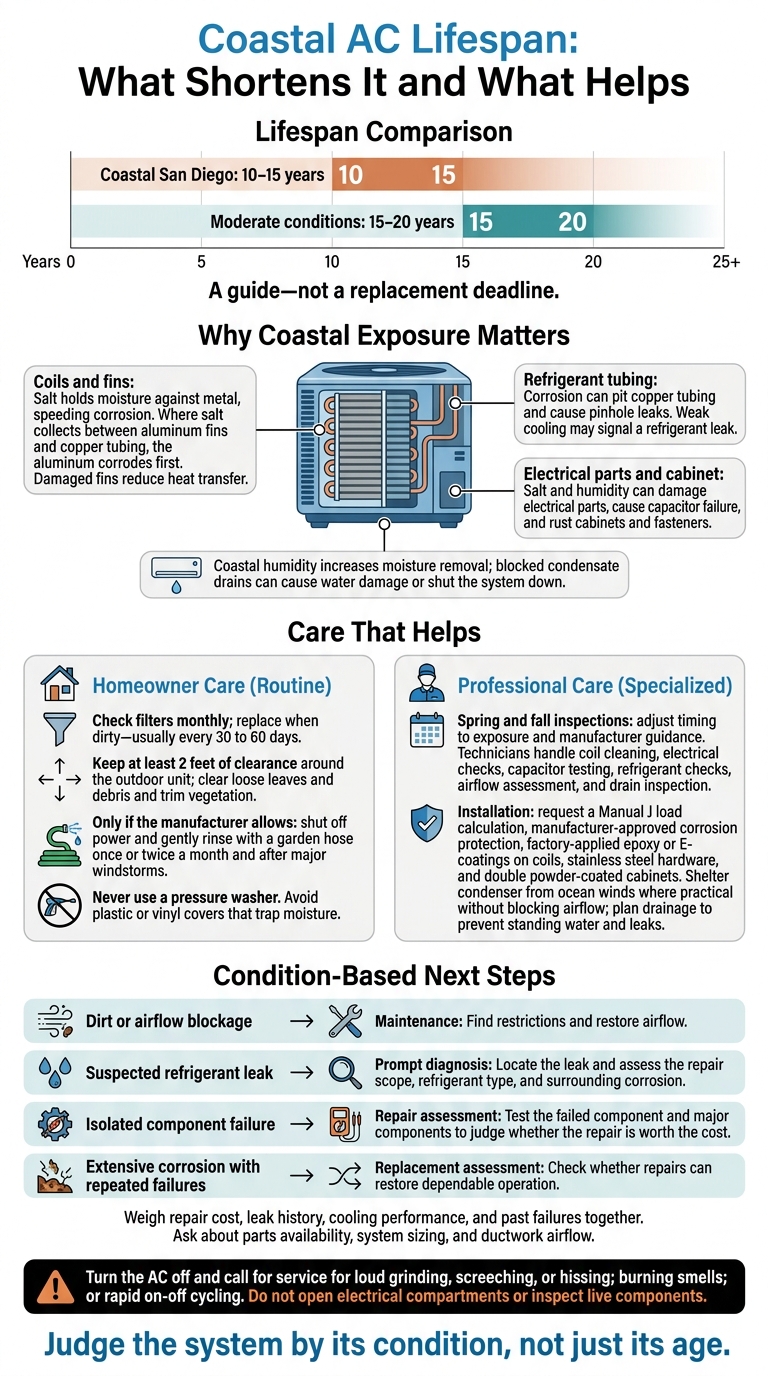
A central AC in coastal San Diego often lasts 10–15 years, compared with 15–20 years in moderate conditions. I’d use that range as a guide - not a replacement deadline. Before paying for repairs or a new system, have a technician check corrosion, leaks, and past failures.
Here’s what I’d focus on to help your AC last:
- Salt exposure: Ocean winds and moisture damage outdoor coils, metal, and electrical parts. Sheltered placement helps, but airflow must stay clear.
- Routine care: Check filters monthly, keep at least 2 feet of clearance, and rinse the outdoor unit only as the manufacturer allows. Never use a pressure washer.
- Installation and inspections: Ask for a Manual J load calculation, approved corrosion protection, and spring and fall checks.
- Repair or replacement: Weigh repair costs, leak history, and cooling performance together. Turn the system off and call for service if you smell burning or hear loud grinding.
My bottom line: <u>judge the system by its condition, not just its age</u>. Repeated failures and heavy corrosion matter more than a birthday.
Coastal AC Lifespan: What Shortens It and What Helps
How Salt and Moisture Damage AC Parts
Salt can damage several parts once it reaches the outdoor unit. It holds moisture against metal, speeding up corrosion. When salt collects between aluminum fins and copper tubing, the aluminum corrodes first.
Corrosion in Coils, Fins, and Refrigerant Tubing
Corroded fins can turn brittle and flake off, reducing heat transfer. As those fins wear down, the system has to run longer to cool your home.
Corrosion can also pit copper refrigerant tubing, creating pinhole leaks that are hard to find. Weak cooling may signal a refrigerant leak, so have the system inspected.
Damage to Electrical Parts, Cabinets, and Drains
Salt and humidity also affect the cabinet, wiring, and drainage. They can wear down electrical parts, causing capacitor failure and making the compressor harder to start. These problems can interrupt cooling and strain the compressor. Cabinet surfaces can rust, while fasteners can seize and make repairs more difficult.
If you see water around the indoor unit, check the condensate drain for blockages. Coastal humidity gives the system more moisture to remove. A blocked drain can cause water damage or trip a safety switch that shuts the system down.
sbb-itb-207f1b2
Maintenance and Installation That Help AC Last
Coastal wear starts at the outdoor unit, so focus your maintenance there first.
Filter and Outdoor Unit Care for Homeowners
Check the filter monthly and replace it when it’s dirty - usually every 30 to 60 days. Clear loose leaves and debris from around the outdoor unit. Keep at least 2 feet of clearance, and trim vegetation before it reaches the cabinet.
If the manufacturer allows rinsing, shut off the power and rinse the condenser with a garden hose once or twice a month and after major windstorms. Never use a pressure washer: it can bend the fins and restrict airflow. Skip plastic or vinyl covers, which trap moisture.
Professional Cleaning and Corrosion Checks
Schedule inspections in spring and fall, adjusting the timing based on coastal exposure and the manufacturer’s guidance. Let a technician handle coil cleaning, electrical checks, capacitor testing, refrigerant checks, airflow assessment, and drain inspection. Visible corrosion or repeated problems may mean the system needs closer monitoring.
Planning an AC Installation Near the Coast
Ask for a Manual J load calculation rather than sizing the system by square footage alone. Look for corrosion-resistant features, including factory-applied epoxy or E-coatings on coils, stainless steel hardware, and double powder-coated cabinets. Use manufacturer-approved corrosion protection.
Where practical, place the condenser on the leeward side of the home - the side sheltered from the wind - or behind a wall or fence. The location should reduce direct exposure to ocean winds without blocking airflow. Route condensate drains to prevent standing water and leaks, and discuss an inspection plan based on the unit’s exposure during installation.
When to Maintain, Repair, or Replace Your AC
When a coastal AC starts failing, corrosion, leak history, and repair cost matter more than age. The question is whether a repair will restore dependable cooling or just put off the next breakdown.
Warning Signs That Need an Inspection
Schedule an inspection if you notice weak cooling, longer cooling cycles, unexplained increases in energy use, repeated failures, unusual noises or odors, indoor water leaks, or chalky corrosion and pitting on outdoor metal.
Turn the AC off until it’s checked if you hear loud grinding, screeching, or hissing, smell burning, or notice rapid on-off cycling. Don’t open electrical compartments or inspect live components.
Suspected refrigerant leaks need a diagnosis - not repeated refills. Adding refrigerant without fixing the leak leaves the problem unresolved.
Maintenance, Repair, and Replacement Decision Table
Use these signs to help decide whether your AC needs maintenance, repair, or replacement.
| Condition | Priority | Next step |
|---|---|---|
| Dirt or airflow blockage | Maintenance | Find restrictions and restore airflow. |
| Suspected refrigerant leak | Prompt diagnosis | Locate the leak and assess the repair scope, refrigerant type, and surrounding corrosion. |
| Isolated component failure | Repair assessment | Test the failed component and major components to judge whether the repair is worth the cost. |
| Extensive corrosion with repeated failures | Replacement assessment | Check whether repairs can restore dependable operation. |
Before approving work, ask about parts availability, system sizing, and ductwork airflow. Replacing a part won’t fix poor sizing or restricted airflow. Bring previous repair records so the technician can tell whether this is a single failure or part of a recurring pattern.
Conclusion: Let Condition and Exposure Guide Replacement
After reviewing warning signs and past repairs, base replacement in coastal San Diego on salt and moisture exposure, maintenance history, and current condition - not age alone.
Look at cooling performance, corrosion, refrigerant leaks, and repair frequency together. Higher energy use, weak airflow, or air that isn’t cool enough can point to corrosion damage. Regular filter changes, gentle hose rinsing, corrosion-resistant installation, and spring and fall inspections help extend service life. Consider replacement when coastal wear makes cooling unreliable.
FAQs
How far inland can salt air affect my AC?
Salt air can reach your AC several miles inland. Onshore breezes can carry microscopic salt particles about 3 to 5 miles, with San Diego’s marine layer and fog helping them travel.
Those particles can speed up corrosion on your outdoor condenser and related components. Homes farther inland usually face less salt exposure than homes right on the coast, but they’re not free from it.
Can corrosion protection help an older AC?
Yes, but the system’s condition matters. When corrosion is minor, professionally applied protective coatings can slow further damage. If the coils have holes or the fins are crumbling, patching usually offers only a temporary fix. Efficiency will likely stay low, and replacement is often more cost-effective.
Regular professional maintenance, including salt rinses and inspections, is needed to manage coastal wear.
Does my AC warranty cover salt damage?
Coverage depends on your manufacturer’s warranty terms. Standard warranties generally cover defects in materials and workmanship. But they often exclude salt-air corrosion because it results from exposure to the surroundings, not a manufacturing defect.
If you’re concerned about your system, CrossBreeze Heating & Air can check your unit and discuss maintenance steps to help protect it from San Diego’s coastal climate.